
Technology
Shopify theme or headless storefront?
The discussion usually starts with performance or design freedom. It is decided by something else: who edits content, who maintains the frontend, and what the setup costs to run two years from now.
Headless is presented as the grown-up option and themes as the starter version. In practice the decision has little to do with maturity. It is a trade between editorial independence, frontend freedom and running cost — and for most brands the honest answer is that a well-built theme covers what they actually need.
A commercial question in technical clothing
Almost every headless project we have reviewed was started for one of two reasons: the site felt slow, or the team felt limited by the theme. Both are real problems, and neither is automatically solved by decoupling the frontend. A slow site is usually slow because of scripts and images. A limiting theme is usually limiting because it was built without a content model.
The questions that actually decide the outcome are less exciting: how often do non-developers need to change pages, how many people can maintain a custom frontend, and who is responsible when a dependency needs updating during the Christmas season.
What a modern theme covers today
The gap between themes and custom frontends has narrowed considerably. Sections and blocks can be arranged on every template, app blocks let third-party functionality be placed without touching code, and structured content can be modelled with metafields and metaobjects rather than being pasted into rich text.
Internationalisation, multiple currencies and market-specific content are handled by the platform. Checkout can be extended in defined places. The result: editorial teams can work without a deployment, and most feature requests become configuration rather than development.
When headless genuinely pays off
There are clear cases, and they have one thing in common: the storefront is not the only thing being built.
- Editorial commerce with a real CMS workflow. Magazine formats, long-form content, complex publishing rules and an editorial team that already works in a dedicated system.
- Several brands or markets on one codebase. When the UX differs substantially per brand but the logic should stay shared, a custom frontend can be cheaper than five diverging themes.
- Interactions the platform does not model. Configurators, quoting flows, portal-like B2B areas or deep integrations with an existing application landscape.
- An existing frontend team. Not a freelancer for the launch — a team that will still be there for maintenance, dependency updates and the next redesign.
The costs that rarely make it into the plan
The app ecosystem stops being plug-and-play. Every app that renders on the storefront needs its own implementation, and app updates become development tickets. That is manageable when planned, and painful when discovered after launch.
The editing workflow has to be replaced. Whatever the theme editor did — arranging sections, scheduling a campaign banner, swapping a hero image — now needs an equivalent in the CMS, or it turns into a developer request.
And there is the permanent side: hosting, build pipeline, monitoring, dependency updates, plus the fact that knowledge concentrates in very few heads. Ask early who operates this in two years, and what happens if that person leaves.
Performance is a discipline, not an architecture
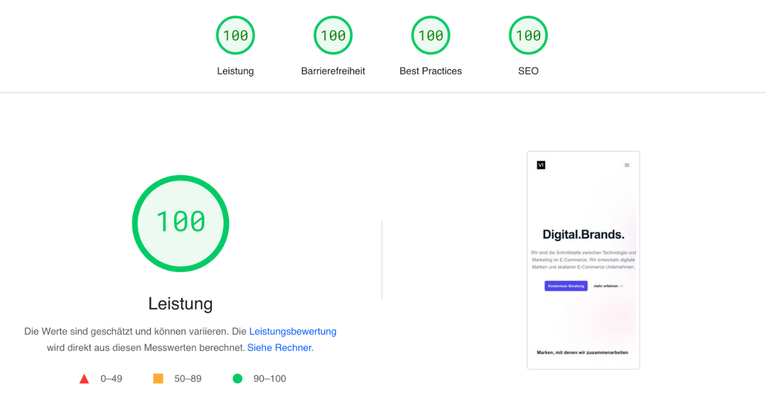
A custom frontend with five marketing tags, three chat widgets and unoptimised hero images is slower than a disciplined theme. The levers that actually move Core Web Vitals are the same in both worlds: how many third-party scripts load, how images are served, how fonts are loaded, how much work happens before the first paint.
We build our own sites as static pages with inlined critical CSS and no client-side framework, because that is the cheapest way to keep scores at the top. The point is not the stack — it is that every additional script has to justify itself.
The fastest shop is not the one with the most modern architecture. It is the one with the fewest scripts.
Five questions that carry the decision
Answer these honestly before comparing technologies:
- How often do non-developers change pages? Weekly campaign changes without a deployment are an argument for the theme; a quarterly release cycle is not.
- Who maintains the frontend in two years? A named team, not a plan. Custom frontends fail quietly when the person who built them moves on.
- Which apps are business-critical? List them and check what each one costs to rebuild. That list is often the whole answer.
- What is genuinely impossible in a theme? Write it down concretely. "More freedom" is not a requirement; a configurator with 200 variants is.
- What is the budget after launch? A custom storefront needs a maintenance budget every year, not only a project budget once.
The middle path that gets overlooked
It is not a binary choice. A theme can be extended with custom app blocks and a private app for the parts that really are specific, while everything standard stays on the platform. A single route — a configurator, a landing area, a B2B portal — can run as a separate application next to the shop.
That path keeps the editorial workflow, keeps the app ecosystem, and puts the development budget exactly where it creates a difference. In most projects it is also the decision that can be reversed later, which is worth more than it sounds.
What to take away
- The decision is about editing workflow, team and running cost — not about how modern the architecture looks.
- Modern themes cover sections, app blocks, structured content, markets and checkout extensions; most requests become configuration.
- Headless pays off for editorial commerce, multi-brand setups, non-standard interactions and teams that will still exist in two years.
- Plan for the hidden costs: rebuilding app functionality, replacing the editor workflow, hosting, updates and key-person risk.
- Performance comes from fewer scripts and better images, in both architectures — and a hybrid path is usually reversible.
Theme, headless or hybrid?
We assess your content workflow, app dependencies and team setup, and give you a recommendation with the running costs attached.
Continue reading
All articles →Analytics
E-commerce KPIs: the short list that works
The revenue equation as a compass, five metrics that are enough to steer a shop, and the numbers that are read wrong most often.
Conversion
The AIDA model in e-commerce
A century-old advertising framework, used as a diagnostic grid for product pages, cart and checkout — including the metrics for each stage.
Cart
Understanding and reducing cart abandonment
Why abandonment is normal, which causes are worth fixing, and why recovery emails are the last step rather than the first.