
Cart
Understanding and reducing cart abandonment
Most carts are never meant to become orders. The useful question is not how to push everyone through, but which of the abandonments were avoidable — and what they have in common.
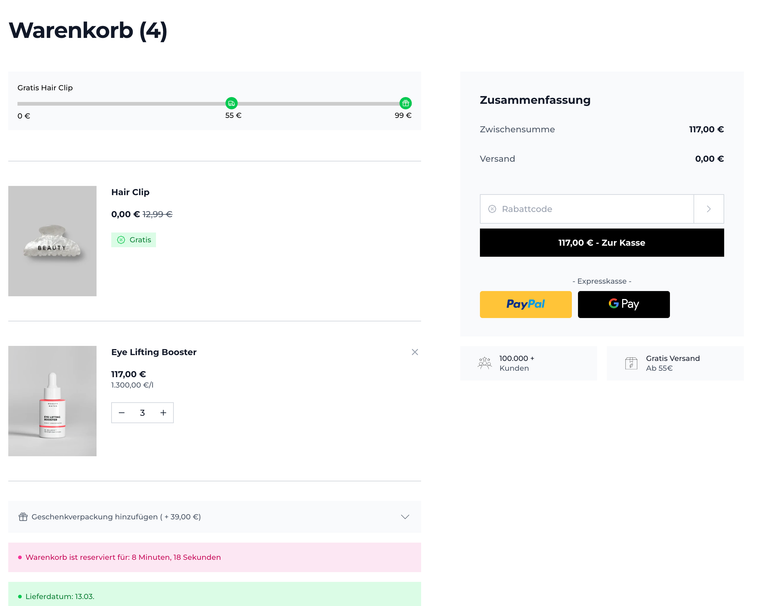
Every shop has an abandonment rate that looks alarming in isolation. Taken on its own, it says almost nothing: carts are used as wish lists, as price memory, as a way to check shipping costs. The number becomes useful only when you separate the people who never intended to buy today from the people who intended to and could not.
Abandonment is the normal case, not the failure
Adding to cart is cheap. It costs one click, no commitment and no data. Many visitors use it to compare, to park an idea, or to find out what shipping will cost — because in most shops that is the only place where the real total appears. Treating all of those sessions as lost revenue leads to the wrong reflex: pressure, discounts, timers.
The productive framing is narrower. Somewhere between the cart and the confirmation page there is a group of people who wanted to order and stopped because of something you control. That group is usually smaller than the raw rate suggests, and it is almost always fixable with the same three or four changes.
Cart abandonment and checkout abandonment are different problems
Measure the chain in three steps: sessions with a cart, sessions that start the checkout, sessions that complete. The gap between step one and step two is a conviction problem — the product, the price, the delivery promise or the trust was not sufficient. The gap between step two and step three is a friction problem — forms, payment methods, errors, unexpected costs.
This matters because the fixes have different owners. Conviction is fixed on product pages and in the cart, by merchandising and content. Friction is fixed in the checkout, by development and payment configuration. Shops that report one combined number tend to spend their effort on whichever explanation is currently fashionable.
The causes that are worth fixing
Across projects, the same reasons come back. None of them are surprising; what is surprising is how often they are known and still unfixed, because each one belongs to a different team.
- Costs that appear late. Shipping, surcharges, duties or payment fees that first become visible inside the checkout are the single most reliable cause of abandonment.
- A vague delivery promise. "2–4 business days" is not an answer when someone needs the item for a specific date. A concrete date removes the reason to postpone.
- Forced account creation. The account is a benefit for you and an obstacle for the customer. Offer it after the purchase, when the data already exists.
- Missing local payment methods. Payment preference is regional. A checkout that works in one market can be unusable in the next one simply because the expected method is absent.
- Missing trust signals. Return conditions, a reachable service contact, a real address and visible reviews do more for completion than any badge.
- Technical friction on mobile. Broken autofill, aggressive address validation, error messages far from the field they belong to — most of this is invisible on a developer's desktop.
Fix it before the checkout, not after the exit
Almost everything on that list can be moved forward. Shipping costs and delivery dates belong on the product page, payment options belong where the decision is made, and the total including shipping should be visible before anyone types an address.
The cart is a selling surface, not a waiting room
A full page change into a cart page pulls people out of the shopping context, and a large share never comes back to browsing. A drawer keeps the context, shows quantity changes without a reload, and can carry exactly the information that would otherwise surprise people later: the free-shipping threshold, the delivery date, the payment options, the return policy in one line.
The discount code field deserves special attention. A prominent empty field is an invitation to leave and search for a code. If you keep it — and there are good reasons to — keep it quiet, and make sure that the search does not end on a coupon site that overwrites your own attribution.
We have built these patterns into our own Shopify app, Verve — Cart Drawer & Bundles , but none of them depend on a specific tool; a well-built theme can do the same.
Recovery is the last step, not the first
Recovery emails and retargeting work — on the group that was already convinced. They are a way to catch interruptions: a phone call, a train stop, a battery. They are not a way to fix a checkout that asks for a phone number twice.
Two messages are usually enough: one shortly after the session, one the next day. Show the cart, show the service contact, and resist the reflex to attach a discount. A discount in the first email teaches people to abandon carts on purpose, and it costs margin on the orders that would have happened anyway.
One caveat that belongs in every plan: sending advertising email to people who are not customers requires a legal basis in the EU, and that question belongs to your legal advisor rather than to the tool that offers the feature.
Measure instead of guessing
Before changing anything, build the three-step funnel and split it by device, by channel and by new versus returning customers. Almost every shop finds one segment where the drop is much steeper than the average — that segment is the project, not the shop as a whole.
Two sources are consistently underused: payment error logs, which show declines and gateway timeouts that never appear in analytics, and session recordings of checkouts that ended abruptly. Ten recordings usually answer a question that a quarter of debate could not.
What to take away
- A raw abandonment rate is not a KPI — separate the sessions that never intended to buy from the ones that failed.
- Split cart abandonment (conviction) from checkout abandonment (friction); they have different causes and different owners.
- Move costs, delivery dates and payment options forward: nothing should be learned for the first time inside the checkout.
- Treat the cart as a selling surface with its own information, not as a page in between.
- Recovery messages catch interruptions; they do not repair a broken checkout, and a reflex discount is expensive.
Find your avoidable abandonments
We rebuild your cart-to-order funnel, isolate the segments that actually drop, and prioritise the fixes by effort and effect.
Continue reading
All articles →Revenue
Raising AOV: bundles, upsells, volume discounts
Which offer works in which place — and how to keep contribution margin from quietly disappearing while revenue goes up.
Strategy
Omnichannel vs. multichannel in practice
The difference is organisational, not technical. How to tell which one you actually run — and what a realistic first step looks like.
MarTech
The MarTech stack a D2C brand really needs
Four jobs a stack has to do, the tools that cover them, and the platforms most brands buy far too early.