
Revenue
Raising AOV: bundles, upsells, volume discounts
Average order value is the cheapest of the three revenue levers, because it needs no additional traffic. It is also the easiest one to fake — which is why every measure has to be checked against margin and returns, not against revenue.
Revenue is sessions times conversion rate times average order value. Traffic costs money and conversion work takes time, so AOV is where most shops look first — and where most shops accidentally trade margin for a bigger number. The question is never "how do we raise AOV", it is "which offer, in which place, without hurting conversion".
AOV is a lever, not a goal
Any measure that raises order value can lower conversion at the same time. A minimum order value does that on purpose. A cart full of offers does it by accident, by adding decisions to a moment that was already decided. The only honest way to judge a measure is to look at revenue per session and at contribution margin, not at AOV alone.
Build the habit of a control group early. Run the offer for a share of traffic, or run it for four weeks against the four weeks before, and always subtract returns. Bundles in particular can look excellent until the return rate on sets arrives four weeks later.
What the average hides
The arithmetic mean is fragile. One wholesale order, one influencer gift package or a single high-ticket item can move a monthly number that nobody has actually influenced. Look at the median alongside the mean; when they drift apart, your average is describing outliers rather than customers.
Split the number the same way you split conversion: by channel, by device, by country, by new versus returning. It is common to find that returning customers already have a much higher order value — in which case the lever is not another upsell, it is getting more people to a second order.
Bundles: when the set is the better answer
Bundles work when they answer a question the customer already has: what do I need to start, what goes with this, what do I give as a gift. They work badly as a pure discount vehicle, because then they only shift volume from full-price single items to discounted sets.
Three things decide whether a bundle earns its place: the price advantage has to be visible but calculated on margin, the set has to be findable on the product page rather than only in a collection, and inventory has to be handled properly — a set that can be sold while one component is out of stock creates a service problem, not revenue.
Patterns that carry
Fixed sets for routines and starter kits. Mix-and-match, where the customer picks a number of items from a defined selection. Volume tiers for consumables. Buy-X-get-Y for introducing a second product. Accessory bundles attached to a main product. Most catalogues support two of these well and the rest badly — the discipline is in choosing.
Upsell and cross-sell: place and timing decide
On the product page, the useful offer is vertical: the larger size, the better variant, the subscription instead of the single purchase. The customer is still deciding what to buy, so a different version of the same thing is welcome — a different product is a distraction.
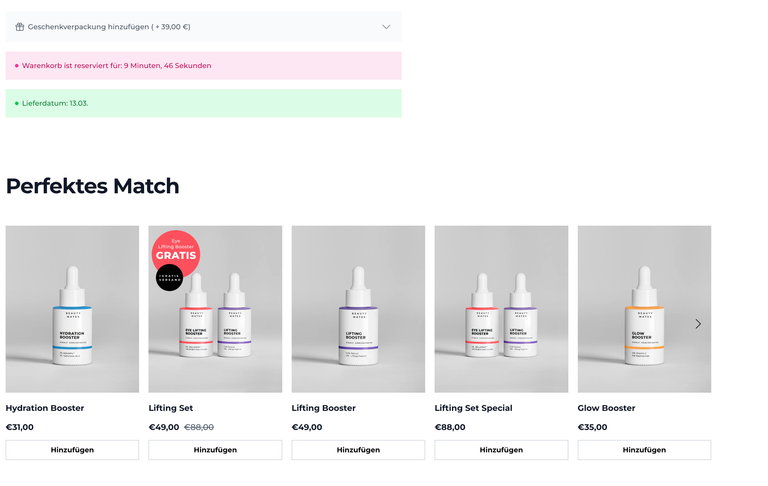
In the cart, the useful offer is horizontal and small: something that complements what is already there and costs clearly less than the main item. One or two suggestions, chosen by relevance rather than by margin. Ten recommendations in a cart do not multiply the chance; they turn a decided purchase back into a browsing session.
After the order, the risk is lowest. A post-purchase offer cannot endanger a checkout that has already completed, and it works well for consumables, refills and accessories. Inside the checkout itself, restraint is the rule: every additional element there competes with the order you already have.
In our own Shopify app, Verve — Cart Drawer & Bundles , bundles, upsells and thresholds deliberately live in the cart drawer rather than in the checkout, for exactly that reason.
Thresholds and volume discounts
The free-shipping threshold is the most effective AOV instrument in most shops, and the most frequently mis-set. Placed at the average order value it changes nothing; placed slightly above the typical order it moves a large share of carts. Show the remaining amount in the cart, and show what is missing rather than what has been reached.
Volume tiers belong to consumables, where buying more is rational for the customer. They come with a delayed cost: a customer who stocks up for six months disappears from your repeat-purchase statistics for six months. That is fine if the margin covers it — it is a problem if your forecast assumed a monthly rhythm.
What quietly breaks AOV programmes
Discount habituation is the classic. If every cart contains an offer, the offer becomes the price, and the next campaign has to be deeper to work at all. The second classic is decision load: a cart with a bundle banner, an upsell row, a gift-wrap option, a discount field and a progress bar is not a cart, it is a landing page.
The third is measurement. Without a control group and without a returns-adjusted view, every measure looks successful, because carts with offers are compared to carts without — and the people who accept offers were the more motivated buyers in the first place.
What to take away
- Judge every AOV measure on revenue per session and contribution margin after returns, never on order value alone.
- Look at the median next to the mean, and split by channel, device, country and customer type.
- Product page: vertical offers. Cart: one or two complementary items. After the order: the lowest-risk place of all.
- Set the free-shipping threshold slightly above the typical order and show what is still missing.
- Too many offers in one view cost conversion — one clear offer per surface beats four competing ones.
Which lever fits your catalogue?
We look at order structure, margin and repeat behaviour, and pick the two measures with the best ratio of effort to effect.
Continue reading
All articles →Strategy
Omnichannel vs. multichannel in practice
The difference is organisational, not technical. How to tell which one you actually run — and what a realistic first step looks like.
MarTech
The MarTech stack a D2C brand really needs
Four jobs a stack has to do, the tools that cover them, and the platforms most brands buy far too early.
Technology
Shopify theme or headless storefront?
A commercial decision dressed up as a technical one. What a modern theme covers, when headless pays off, and what it costs to run.